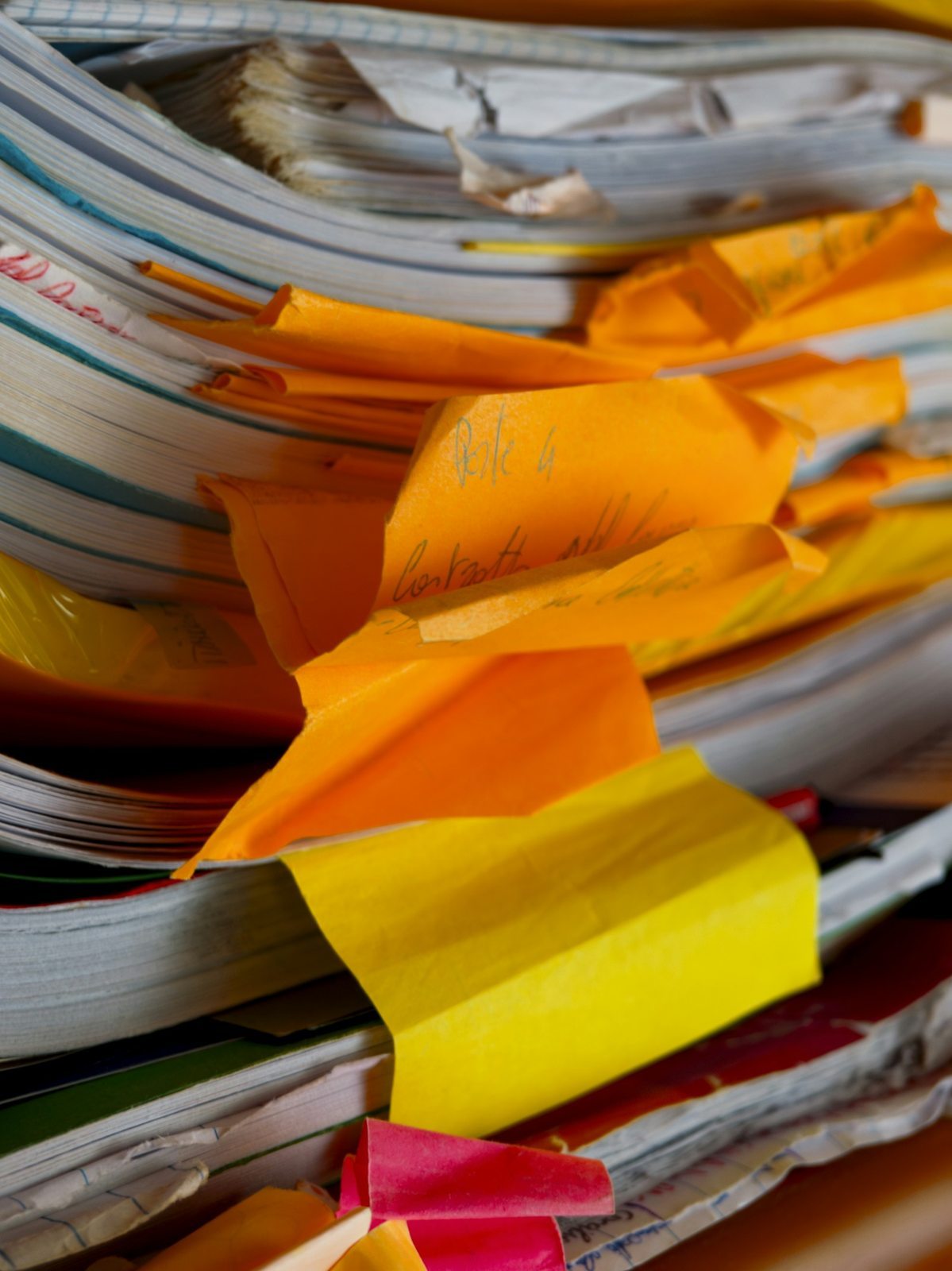
Paper clutter often contains several unfinished decisions disguised as one pile. A letter needs a reply, a receipt needs checking, an instruction sheet belongs with an appliance, and a document is waiting because you are unsure whether to keep it. Buying a file box gives the pile boundaries, but it does not resolve those different jobs. Use this decision flow on a manageable handful of papers and give each item one clear next destination.
A FEW THINGS TO TAKE WITH YOU
- Ask whether action is needed before choosing a filing category.
- Give uncertain documents a specific question and a review date.
- Do not assume a digital copy replaces an original or that a generic retention timetable fits your circumstances.
Read the item, then follow the next question
Take one document at a time. Read enough to identify the sender, purpose, and any stated deadline. Keep related pages together. If the paper belongs to another household member, hand it to them or use an agreed personal inbox rather than deciding its value yourself.
The flow below creates four destinations: action, reference, question, and exit. These can be existing folders or small piles during the sorting session. They do not require a new filing cabinet. Clear the temporary piles before you finish so today's organizing does not become tomorrow's extra layer.
| Question | If yes | If no |
|---|---|---|
| Is this mine to handle? | Continue to the next question | Route it to the appropriate person |
| Does it require an action? | Record the action and deadline, then place it in Action | Ask whether it has a known reference purpose |
| Do I know why I need to keep it? | File it under a useful retrieval name | Ask whether retention or replacement is uncertain |
| Is there a specific unresolved question? | Place it in Question with an owner and review date | Use the appropriate disposal or return route |
An action starts with a verb
'Insurance' is a topic; 'check the renewal details and decide how to respond' is an action. Write the action in the task system you actually consult, with the document's location. Add a deadline when the document provides one and distinguish it from a date you choose to review it. The paper should not be the only reminder of the task.
If completing the action leaves a document you need to keep, move it to reference afterward. Otherwise use the appropriate exit route. Do not leave a completed item in the action folder merely because it arrived there first. That is how a tray becomes both an urgent inbox and an archive that must be searched before every task.
When several papers relate to one action, give them one group name. For example, a booking confirmation and a related form can travel together until the appointment is complete. You are organizing the work, not sorting paper by size or color.
File reference material by the question you will ask later
Imagine looking for the paper six months from now. Would you remember the provider, the object, the address, or the event? Choose the label that matches that likely search. 'Desk assembly instructions' may be more useful than 'miscellaneous household documents.' Avoid making so many categories that filing one page requires a lengthy classification decision.
If you keep a digital copy, use a consistent filename and check that every relevant page is readable. Note where the physical original is held when it is retained. Digitizing can improve retrieval, but the choice to keep or discard an original depends on the document and your circumstances. Check the relevant issuer or qualified adviser when that choice matters.
Do not adopt a universal retention period from this organizational exercise. Financial, legal, immigration, medical, and other records can have different requirements. The useful contribution here is a findable location and a clear question, not a guessed timetable.
Give uncertainty a route out
An uncertainty folder is useful only if its contents have questions attached. 'Do I need the original after submitting this form?' is actionable. 'Maybe important' simply transfers indecision into a labeled container. Write who can answer the question and when you intend to ask.
Use a small, defined space and review it before it fills. Capacity is a prompt to resolve questions, not a reason to discard papers indiscriminately. If a document affects a consequential decision, retain it while you obtain appropriate guidance. For an ordinary product leaflet, the question may be as simple as whether a current official copy is available and useful to you.
A four-item walkthrough
Imagine an incoming stack with an appointment letter, a furniture instruction sheet, a document with uncertain original-copy requirements, and an unwanted flyer. The appointment letter goes to Action after its date and task are recorded. The instruction sheet goes to Reference under the furniture's name. The uncertain document gets a specific question and a planned inquiry. The flyer can leave through the suitable disposal route.
These are illustrative decisions, not instructions to discard particular real documents. Check each item's content, ownership, and relevant requirements. For papers carrying personal information, use a disposal method appropriate to that information and your circumstances rather than putting them into an open household pile.
Finish by returning the working surface to use. At your next review, read the Action and Question lists first. A small amount of paper can remain in a well-run home; the goal is for each piece to have a reason and a next step.
About this guide
This guide provides planning prompts and comparison criteria. It does not report product tests or results from a real household.
This guide offers general home-planning ideas. Product instructions and your own rental agreement take precedence. How we approach our guides.